双球座標系の図。双極座標系の2つの焦点を結ぶ軸を中心に回転させることによって得られる。焦点は (x, y, z) = (0, 0, ±1)。赤、青、黄はそれぞれ σ = π/4、τ = 1/2、φ = π/3 の等値面である。黒の点は等値面の交点で、 (x, y, z) ≈ (0.841, -1.456, 1.239) である。
双球座標系(英語: bispherical coordinates)は3次元の直交座標系の一つで、2次元の双極座標系を、2つの焦点を結ぶ軸を中心に回転させたものである。そのため、双球座標系の2焦点は回転軸上の点として維持される。
定義
 (
( )を焦点とする双球座標
  は以下のように定義される:
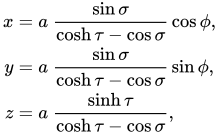
逆変換は
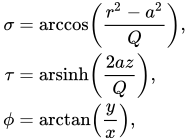
で、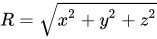 、
、 である。座標
  は焦点
は焦点  で、
で、 は z 軸上で不定となる。
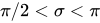
各座標の範囲は
![{\displaystyle {\begin{aligned}\sigma &\in [0,\pi ],\\\tau &\in (-\infty ,\infty ),\\\phi &\in [0,2\pi )\end{aligned}}}](https://wikimedia.org/api/rest_v1/media/math/render/svg/12ff8307896129069252df646c2b401a0e678bbc)
である。
微分
双球座標系のヤコビ行列は

である。したがって計量テンソルは
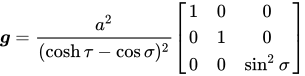
である。
これより、微小体積要素は
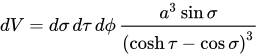
となる。また、ラプラシアンは以下で与えられる:
![{\displaystyle \nabla ^{2}f={\frac {(\cosh \tau -\cos \sigma )^{3}}{a^{2}}}\left[{\frac {1}{\sin \sigma }}{\frac {\partial }{\partial \sigma }}\left({\frac {\sin \sigma }{\cosh \tau -\cos \sigma }}{\frac {\partial f}{\partial \sigma }}\right)+{\frac {\partial }{\partial \tau }}\left({\frac {1}{\cosh \tau -\cos \sigma }}{\frac {\partial f}{\partial \tau }}\right)+{\frac {1}{\sin ^{2}\sigma \left(\cosh \tau -\cos \sigma \right)}}{\frac {\partial ^{2}f}{\partial \phi ^{2}}}\right]}](https://wikimedia.org/api/rest_v1/media/math/render/svg/8c72fa19dd5982adabd0fc7003833f841cdba0d2)
参考文献
- Morse PM, Feshbach H (1953). Methods of Theoretical Physics, Part I. New York: McGraw-Hill. pp. 665–666
- Korn GA, Korn TM (1961). Mathematical Handbook for Scientists and Engineers. New York: McGraw-Hill. p. 182. LCCN 59-14456
- Zwillinger D (1992). Handbook of Integration. Boston, MA: Jones and Bartlett. p. 113. ISBN 0-86720-293-9
- Moon PH, Spencer DE (1988). “Bispherical Coordinates (η, θ, ψ)”. Field Theory Handbook, Including Coordinate Systems, Differential Equations, and Their Solutions (corrected 2nd ed., 3rd print ed.). New York: Springer Verlag. pp. 110–112 (Section IV, E4Rx). ISBN 0-387-02732-7