

ニクズク科
| ニクズク科 | |||||||||||||||
|---|---|---|---|---|---|---|---|---|---|---|---|---|---|---|---|
.jpg)  | |||||||||||||||
| 分類 | |||||||||||||||
| |||||||||||||||
| 学名 | |||||||||||||||
| Myristicaceae Diels (1917)[1] | |||||||||||||||
| タイプ属 | |||||||||||||||
| ニクズク属 Myristica Gronov. (1755)[2] | |||||||||||||||
| 英名 | |||||||||||||||
| nutmeg family[2][3] | |||||||||||||||
| 下位分類 | |||||||||||||||
ニクズク科(ニクズクか、学名: Myristicaceae)は、モクレン目の科の1つである。常緑性の木本であり、樹液は有色(通常は赤色)。花は小さく単性、花被片はふつう3枚で合生(図1a)、多数の雄しべが合生した単体雄しべをもち、雌しべは1個。種子はふつう派手な仮種皮で包まれ(図1b)、胚乳には虫食い状の陥入がある。世界中の熱帯域に分布し、約20属500種ほどが知られる。ニクズク(Myristica fragrans)の種子は、香辛料のナツメグやメースとして広く利用されている。
特徴
常緑性まれに落葉性[注 1]の高木から低木であり、まれにつる性(藤本)、精油を含み、ときに芳香をもつ[4][1](下図2a)。枝はしばしば輪生状で横に伸びる[1][5][3](下図2b)。樹液は有色(ふつう赤色)[4][1][6][5][3](下図2c)。一次維管束は管状[4][5]。木部にタンニンを含む管をもつ[5]。師管の色素体はS-type[4]。節は単葉隙、3葉跡性[4]。
.jpg)

_Warb._(8455860186).jpg)
葉はふつう2列互生する[4][5][3](下図3)。葉は葉柄をもち、托葉を欠き、単葉、全縁、革質、葉脈は羽状、ときに腺点をもつ[4][1][3](下図3)。ふつう分泌道をもつ[4]。気孔は平行型[4]。毛(毛状突起)は多様だが、基本的に仮軸分枝した単列毛[4][5]。

.jpg)
花は小さく単性(雄花と雌花が別)、ふつう雌雄異株だがまれに雌雄同株[4][1][6][5][3](下図4)。花序を腋生(ときに幹生)、または頂生する[4][1]。花被は放射相称で漏斗形、鐘形、つぼ形、皿形など、花被片は(2–)3(–5)枚、ときに肉質、白色、緑色、黄色など、1輪、敷石状、基部で合生[4][1][6][5][3](下図4)。雄しべは(2–)3–30(–40)個、1輪、多くは花糸が合生して単体雄しべとなる[4][1][6][5][3](下図4c)。葯は外向、縦裂開する[4][1]。小胞子形成は同時型、タペート組織は分泌型[4]。花粉は単溝粒、単孔粒または無孔粒、2細胞性[4][3]。雌しべは1個、1心皮性、不完全心皮、柱頭はしばしば2裂し、子房上位で1胚珠を含み、基底胎座[4][1][6][5][3]。倒生胚珠、2珠皮性、厚層珠心、珠孔は内種皮性[4][1][5]。胚嚢形成はタデ型、胚乳形成は遊離核型[4]。蜜腺を欠く[3]。
_Paramin_Trinidad_2.jpg)
.jpg)
_Warb._(8256497139).jpg)
果実は液質から革質、ふつう腹縫線と背縫線の両方で裂開する袋果(まれに非裂開)[4][1][3](下図5a, b)。種子は1個、大きく、ふつう派手な色の仮種皮で包まれている[4][1][6][5](下図5a, b)。内胚乳にはふつう虫食い状の入り組んだ陥入(錯道)があり(下図5c)、ふつう油質[4][1][6][3]。胚はよく分化しているが、非常に小さい[4][1][3]。地下子葉性[4]。


幻覚誘発性のフェノール化合物(ミリスチシンなど)をもつ[3]。アルカロイド、プロアントシアニジン、フラボノール(ケンペロール、クェルセチン)を有し、シアン化物、イソキノリン、イリドイドを欠く[4][5]。染色体数は n = 20, 22, 25, 26[4]。
分布・生態

アジアからオーストラリア、アフリカ、アメリカの熱帯域に分布しており、おもに低地の熱帯雨林に生育している[6][5][3](図6)。
少なくとも東南アジアでは、小型の甲虫によって送粉される例が多い[5]。またニクズク属の雌花は花粉を形成しないが、花粉を集めるハナバチ類を騙して送粉させることが示唆されている[5]。
仮種皮は薄いが栄養分に富んでおり、これを報酬として旧世界ではサイチョウ類、ハト類、フウチョウ類が、新世界ではオオハシ類や霊長類が種子散布を行う[5]。
人間との関わり

ニクズク(Myristica fragrans)の種子(内部の胚乳)はナツメグ(nutmeg)、仮種皮はメース(mece)とよばれ、香辛料として広く利用されている[6][7][8](図7)。ニクズクやチョウジ(フトモモ科)、コショウ(コショウ科)、シナモン(クスノキ科)などの香辛料に対する需要が、15–16世紀の大航海時代の引き金の1つとなった[6]。ニクズク属の種子は、薬用に用いられることもある[7][8]。
Staudtia や Virola は、木材として利用されることがある[3]。また Virola のいくつかの種は、幻覚誘発剤の原料とされることがある[6][3]。
系統と分類
古典的な被子植物の分類体系である新エングラー体系やクロンキスト体系では、ニクズク科はモクレン目に分類されていた[9][10][11][12]。その後一般的となったAPG分類体系でも、ニクズク科はモクレン目に分類されている[13]。モクレン目の中では、ニクズク科は最初に分岐したグループであると考えられている[5]。
ニクズク科の中には、約20属500種ほどが知られている[5]。ニクズク科の中では、最初にアフリカ・マダガスカルに分布するものが分岐し(Mauloutchieae連とScyphocephalieae連、側系統)、次にアジアからオーストラリアに分布するものが分岐(Myristiceae連とHorsfieldieae連、側系統)、中南米に分布するものが単系統群(Viroleae連)を形成し、アフリカに分布する Coelocaryon が姉妹群であることが示唆されている[14](下図8)。
| |||||||||||||||||||||||||||||||||
| 8. ニクズク科内の系統仮説[1][14](カッコ内は分布域) |
- ニクズク科 Myristicaceae Diels (1917)
- 連 Mauloutchieae Ezedin & Sauquet (2025)
- 葉の芽内形態は片巻き型。ふつう雌雄同株。雄しべの合着度は多様、葯はふつう離生で底着。花粉はふつう球形で単孔粒、エキシンは彫紋状や顆粒状(Pycnanthus では平滑で棘状)。Maloutchia は仮種皮を欠く。内胚乳の錯道はまれ。[5]
- Brochoneura Warb. (1895)[15]
- = Neobrochoneura Figueiredo & Gideon F.Sm. (2020)[14]
- 3種が知られる。マダガスカルに分布する。
- Cephalosphaera Warb. (1903)[14](図9a)

9a. Cephalosphaera usambarensis - Doyleanthus Sauquet (2003)[16]
- 1種のみが知られる。マダガスカルに分布する。
- Mauloutchia Warb. (1895)[17]
- 9種が知られる。マダガスカルに分布する。
- Pycnanthus Warb. (1895)[18]
- 4種が知られる。熱帯アフリカに分布する。
- Staudtia Warb. (1897)[19]
- 2種が知られる。熱帯アフリカに分布する。
- 連 Scyphocephalieae Ezedin & Sauquet (2025)
- 連 Myristiceae Ezedin & Sauquet (2025)
- 葉の芽内形態は二つ折り型。ふつう雌雄異株。花序基部の低出葉を欠く。雄しべは合着、葯は隔壁を欠く。花粉のエキシンは彫紋状で網状からシワ状。心皮は背軸側の維管束を欠く。内胚乳に錯道がある。種子はデンプンも含む。[5]
- 連 Horsfieldieae Ezedin & Sauquet (2025)
- 葉の芽内形態は二つ折り型。ふつう雌雄異株。雄しべは合着、葯は隔壁をもつ。花粉のエキシンは彫紋状で網状。心皮は背軸側に2本の維管束がある。内胚乳に錯道がある。[5]
- Endocomia W.J.de Wilde (1984)[24]
- 4種が知られる。中国南部・東南アジア・ニューギニア島に分布する。
- Gymnacranthera Warb. (1895)[25]
- 7種が知られる。南アジア・東南アジア・ニューギニア島に分布する。
- ホルスフィエルディア属[6] Horsfieldia Willd. (1806)[26](図9c)

9c. Horsfieldia kingii の果実、種子
- 連 Viroleae S.M.Oliveira & Sauquet (2025)
- Bicuiba J.J.de Wilde (1991)[27]
- 1種のみが知られる。南米に分布する。
- Compsoneura (DC.) Warb. (1897)[28](図9d)

9d. Compsoneura excelsa - 17種が知られる。中南米に分布する。
- Iryanthera (DC.) Warb. (1895)[29]
- 22種が知られる。中南米に分布する。
- Osteophloeum Warb. (1897)[30]
- 1種のみが知られる。南米に分布する。
- Otoba (DC.) H. Karst. (1882)[31]
- ウィロラ属[6] Virola Aubl. (1775)[32](図9e)
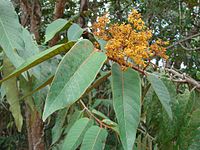
9e. Virola sebifera - 60種が知られる。中南米に分布する。
- Bicuiba J.J.de Wilde (1991)[27]
- 連不明
- Coelocaryon Warb. (1895)[33]
- 4種が知られる。熱帯アフリカに分布する。
- Haematodendron Capuron (1972)[34]
- 1種のみが知られる。マダガスカルに分布。
- Coelocaryon Warb. (1895)[33]
- 連 Mauloutchieae Ezedin & Sauquet (2025)


脚注
注釈
出典
- 1 2 3 4 5 6 7 8 9 10 11 12 13 14 15 16 17 18 19 “Myristicaceae”. Plants of the World Online. Kew Botanical Garden. 2022年7月12日閲覧。
- 1 2 “Myristicaceae R. Br.”. Tropicos v3.3.2. Missouri Botanical Garden. 2022年8月10日閲覧。
- 1 2 3 4 5 6 7 8 9 10 11 12 13 14 15 16 17 18 Judd, W.S., Campbell, C.S., Kellogg, E.A., Stevens, P.F. & Donoghue, M.J. (2015). “Myristicaceae”. Plant Systematics: A Phylogenetic Approach. Academic Press. p. 255. ISBN 978-1605353890
- 1 2 3 4 5 6 7 8 9 10 11 12 13 14 15 16 17 18 19 20 21 22 23 24 25 26 27 Watson, L. & Dallwitz, M. J. (1992 onwards). “Myristicaceae R. Br.”. The families of flowering plants: descriptions, illustrations, identification, and information retrieval.. 2022年7月12日閲覧。
- 1 2 3 4 5 6 7 8 9 10 11 12 13 14 15 16 17 18 19 20 21 22 23 24 Stevens, P. F. (2001 onwards). “MYRISTICACEAE”. Angiosperm Phylogeny Website. 2022年7月12日閲覧。
- 1 2 3 4 5 6 7 8 9 10 11 12 13 14 15 トーマス・ウィルソン & 植田邦彦 (1997). “ニクズク科”. 週刊朝日百科 植物の世界 9. pp. 98–100. ISBN 9784023800106
- 1 2 星川清親, 堀田満, 新田あや (1989). “ニクズク属”. In 堀田満ほか. 世界有用植物事典. 平凡社. pp. 700–701. ISBN 9784582115055
- 1 2 「ナツメグ」。コトバンクより2022年8月9日閲覧。
- ↑ 加藤雅啓 (編) (1997). “分類表”. バイオディバーシティ・シリーズ (2) 植物の多様性と系統. 裳華房. p. 270. ISBN 978-4-7853-5825-9
- ↑ 井上浩, 岩槻邦男, 柏谷博之, 田村道夫, 堀田満, 三浦宏一郎 & 山岸高旺 (1983). “モクレン目”. 植物系統分類の基礎. 北隆館. pp. 219–222
- ↑ Melchior, H. (1964). A. Engler's Syllabus der Pflanzenfamilien mit besonderer Berücksichtigung der Nutzpflanzen nebst einer Übersicht über die Florenreiche und Florengebiete der Erde. I. Band: Allgemeiner Teil. Bakterien bis Gymnospermen
- ↑ Cronquist, A. (1981). An integrated system of classification of flowering plants. Columbia University Press. ISBN 9780231038805
- ↑ Chase, M. W., Christenhusz, M. J. M., Fay, M. F., Byng, J. W., Judd, W. S., Soltis, D. E., ... & Stevens, P. F. (2016). “An update of the Angiosperm Phylogeny Group classification for the orders and families of flowering plants: APG IV”. Botanical Journal of the Linnean Society 181 (1): 1-20. doi:10.1111/boj.12385.
- 1 2 3 4 5 Helmstetter, A. J., Ezedin, Z., de Lírio, E. J., de Oliveira, S. M., Chatrou, L. W., Erkens, R. H., ... & Sauquet, H.. “Toward a phylogenomic classification of magnoliids”. American Journal of Botany 112 (1): e16451. doi:10.1002/ajb2.16451.
- ↑ “Brochoneura”. Plants of the World Online. Kew Botanical Garden. 2025年3月7日閲覧。
- ↑ “Doyleanthus”. Plants of the World Online. Kew Botanical Garden. 2025年3月7日閲覧。
- ↑ “Mauloutchia”. Plants of the World Online. Kew Botanical Garden. 2025年3月7日閲覧。
- ↑ “Pycnanthus”. Plants of the World Online. Kew Botanical Garden. 2025年3月7日閲覧。
- ↑ “Staudtia”. Plants of the World Online. Kew Botanical Garden. 2025年3月7日閲覧。
- ↑ “Scyphocephalium”. Plants of the World Online. Kew Botanical Garden. 2025年3月7日閲覧。
- ↑ “Knema”. Plants of the World Online. Kew Botanical Garden. 2025年3月7日閲覧。
- ↑ “Myristica”. Plants of the World Online. Kew Botanical Garden. 2025年3月7日閲覧。
- ↑ “Paramyristica”. Plants of the World Online. Kew Botanical Garden. 2025年3月7日閲覧。
- ↑ “Endocomia”. Plants of the World Online. Kew Botanical Garden. 2025年3月7日閲覧。
- ↑ “Gymnacranthera”. Plants of the World Online. Kew Botanical Garden. 2025年3月7日閲覧。
- ↑ “Horsfieldia”. Plants of the World Online. Kew Botanical Garden. 2025年3月7日閲覧。
- ↑ “Bicuiba”. Plants of the World Online. Kew Botanical Garden. 2025年3月7日閲覧。
- ↑ “Compsoneura”. Plants of the World Online. Kew Botanical Garden. 2025年3月7日閲覧。
- ↑ “Iryanthera”. Plants of the World Online. Kew Botanical Garden. 2025年3月7日閲覧。
- ↑ “Osteophloeum”. Plants of the World Online. Kew Botanical Garden. 2025年3月7日閲覧。
- ↑ “Otoba”. Plants of the World Online. Kew Botanical Garden. 2025年3月7日閲覧。
- ↑ “Virola”. Plants of the World Online. Kew Botanical Garden. 2025年3月7日閲覧。
- ↑ “Coelocaryon”. Plants of the World Online. Kew Botanical Garden. 2025年3月7日閲覧。
- ↑ “Haematodendron”. Plants of the World Online. Kew Botanical Garden. 2025年3月7日閲覧。
外部リンク


- Kabeya, Y. & Hasebe, M.. “モクレン類/モクレン目/ニクズク科”. 陸上植物の進化. 基礎生物学研究所. 2022年7月12日閲覧。
- Stevens, P. F. (2001 onwards). “MYRISTICACEAE”. Angiosperm Phylogeny Website. 2022年7月12日閲覧。(英語)
- Watson, L. & Dallwitz, M. J. (1992 onwards). “Myristicaceae R. Br.”. The families of flowering plants: descriptions, illustrations, identification, and information retrieval.. 2022年7月12日閲覧。(英語)
- “Myristicaceae”. Plants of the World Online. Kew Botanical Garden. 2022年7月12日閲覧。(英語)