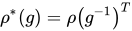
が群で、 がベクトル空間 上の の線型表現であるとき、反傾表現(はんけいひょうげん、英: contragredient representation)あるいは双対表現(そうついひょうげん、英: dual representation) は以下のようにして双対ベクトル空間 上定義される[1]:

は の転置である、つまり、すべての に対して である。

がリー環で がベクトル空間 上のその表現であれば、反傾表現 は以下のようにして双対ベクトル空間 上定義される[2]:

すべての に対して である。

いずれの場合にも、反傾表現は通常の意味での表現である。

ユニタリ表現に対しては、反傾表現は共役表現(フランス語版)と等しい。

動機付け

表現論において、 のベクトルと の線型汎関数はいずれも列ベクトルと考え、したがって表現は左から(行列の乗法によって)作用できる。線型汎関数 の への作用 は行列の乗法

によって表現できる。ただし上付きの は行列の転置を表す。群の作用と整合的であるためには

が要求される[3]。反傾表現の定義から、

となり、整合性を持つことが確かめられる。

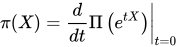
リー環の表現に対しては、対応するリー群の表現との整合性を課す。一般に、 がリー群の表現であれば、

によって与えられる はそのリー環の表現である。 が に双対であれば、その対応するリー環の表現 は、

で与えられる[4]。

一般化

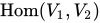
すべての とすべての に対して、。
反傾表現は、 が自明表現の場合である。

関連項目

参考文献

  1. ↑ Lecture 1 of Fulton, William; Harris, Joe (1991), Representation theory. A first course, Graduate Texts in Mathematics, Readings in Mathematics, 129, New York: Springer-Verlag, ISBN 978-0-387-97495-8, MR1153249, ISBN 978-0-387-97527-6, p. 4
  2. ↑ Lecture 8 of Fulton, William; Harris, Joe (1991), Representation theory. A first course, Graduate Texts in Mathematics, Readings in Mathematics, 129, New York: Springer-Verlag, ISBN 978-0-387-97495-8, MR1153249, ISBN 978-0-387-97527-6, p. 111
  3. ↑ Lecture 1, page 4 of Fulton, William; Harris, Joe (1991), Representation theory. A first course, Graduate Texts in Mathematics, Readings in Mathematics, 129, New York: Springer-Verlag, ISBN 978-0-387-97495-8, MR1153249, ISBN 978-0-387-97527-6
  4. ↑ Lecture 8, page 111 of Fulton, William; Harris, Joe (1991), Representation theory. A first course, Graduate Texts in Mathematics, Readings in Mathematics, 129, New York: Springer-Verlag, ISBN 978-0-387-97495-8, MR1153249, ISBN 978-0-387-97527-6
  5. ↑ A. Chambert-Loir, Introduction aux groupes et algèbres de Lie, cours de master 2 à l'université de Rennes 1 (2004-2005), p. 21
⌬ Phoenix Mesh CID: 未登録 IPFS未登録 📡 0ピア N=1 CRITICAL PQS C44