さまざまな部品の故障率のハンドブックが政府や民間から入手できる。「電子機器の信頼度予測(Reliability Prediction of Electronic Equipment)」(MIL-HDBK-217F)は、多くの軍用電子部品の故障率データを提供する軍用規格である。また、非電子部品を含む商用部品に焦点を当てたいくつかの故障率データソースが市販されている。
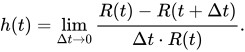
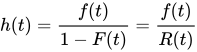
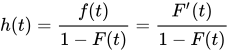
ハザード率(後述)とROCOF(rate of occurrence of failures、故障発生率)は、しばしば故障率と同じものと誤解されることがある[要説明]。違いを明確にするならば、アイテムの修理が早ければ早いほど、またすぐに壊れるので、ROCOFは高くなる。しかし、ハザード率は、修復時間や物流遅延時間には依存しない。
故障率増加型(Increasing failure rate、IFR)は、部品が消耗することによって起こる直感的な概念である。故障率減少型(DFR)は、経年変化によって改善されるシステムを表す[6]。宇宙船の寿命においても故障率減少型が見られ、Baker and Bakerは『最後に残ったこれらの宇宙船は、延々と続く。』("These spacecraft that last, last on and on.")とコメントしている[7][8]。航空機の空調システムの信頼性は、個々に指数分布を持つことが分かっており、プールされた母集団ではDFRとなる[6]。
単一故障点をなくすために「冗長」部品を追加すると、ミッション故障率は改善するが、直列故障率(ロジスティクス故障率とも呼ばれる)は悪化する。つまり、追加の部品は平均重大故障間隔(mean time between critical failures、MTBCF)を改善させる反面、何かが故障するまでの平均時間は悪化する[14]。
1 2 Brown,M.(1980).“Bounds, Inequalities, and Monotonicity Properties for Some Specialized Renewal Processes”.The Annals of Probability8(2): 227–240.doi:10.1214/aop/1176994773.JSTOR2243267.
1 2 Shanthikumar,J. G.(1988).“DFR Property of First-Passage Times and its Preservation Under Geometric Compounding”.The Annals of Probability16(1): 397–406.doi:10.1214/aop/1176991910.JSTOR2243910.
↑ Brown,M.(1981).“Further Monotonicity Properties for Specialized Renewal Processes”.The Annals of Probability9(5): 891–895.doi:10.1214/aop/1176994317.JSTOR2243747.
↑ Yu,Y.(2011).“Concave renewal functions do not imply DFR interrenewal times”.Journal of Applied Probability48(2): 583–588.arXiv:1009.2463.doi:10.1239/jap/1308662647.
↑ Baker,J. C.;Baker,G. A. S. .(1980).“Impact of the space environment on spacecraft lifetimes”.Journal of Spacecraft and Rockets17(5): 479.Bibcode:1980JSpRo..17..479B.doi:10.2514/3.28040.
Goble,William M.(2018),Safety Instrumented System Design: Techniques and Design Verification,Research Triangle Park, NC 27709:International Society of Automation
Blanchard,Benjamin S.(1992).Logistics Engineering and Management(Fourth ed.).Englewood Cliffs, New Jersey:Prentice-Hall.pp.26–32.ISBN0135241170
Ebeling,Charles E.(1997).An Introduction to Reliability and Maintainability Engineering.Boston:McGraw-Hill.pp.23–32.ISBN0070188521
Kapur,K. C.;Lamberson,L. R.(1977).Reliability in Engineering Design.New York:John Wiley & Sons.pp.8–30.ISBN0471511919
Knowles,D. I.(1995).“Should We Move Away From 'Acceptable Failure Rate'?”.Communications in Reliability Maintainability and Supportability(International RMS Committee, USA)2(1): 23.
MacDiarmid,Preston;Morris,Seymour(n.d.).Reliability Toolkit(Commercial Practices ed.).Rome, New York:Reliability Analysis Center and Rome Laboratory.pp.35–39