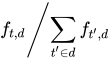
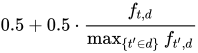
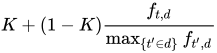
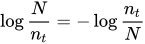
情報検索 の分野において、tf–idf (または、 TF*IDF 、TFIDF 、TF–IDF 、Tf–idf )は、term frequency–inverse document frequency の略であり、コーパス や収集された文書 群において、ある単語 がいかに重要なのかを反映させることを意図した統計量 (数値 )である[1] テキストマイニング 、ユーザーモデリング (英語版 ) 重み係数 (英語版 ) 比例 して増加し、また、その単語を含むコーパス内の文書数によってその増加が相殺される。この性質は、一般にいくつかの単語はより出現しやすいという事実をうまく調整することに役立っている。今日、tf-idfはもっとも有名な語の重みづけ(term-weighting)手法である。2015年に行われた研究では、電子図書館 におけるテキストベースのレコメンダシステム のうち83%がtf-idfを利用していたことがわかった[2]
tf-idfの重み付け手法を変形したものは、ユーザーのクエリ(検索ワード)から文書の適合性 を得点化し、順位づけする際の中心的なツールとして、よく検索エンジン で用いられている。tf-idfは、自動要約 や文書分類 といった様々な分野において、ストップワード (英語版 )
最もシンプルな順位付け関数(ranking function) (英語版 )
英語文書の集合を扱っていると仮定し、それらを"the brown cow"というクエリにより関連する順に並べたいとする。問題に取り掛かる上で、シンプルな方法は、"the"、"brown"、"cow"の3つの単語のすべてを含まない文書を除くことであるが、これではたくさん文書がまだ残ってしまう。さらにそれらを区別するために、もしかすると各文書で各単語が何度出現しているかを数えるかもしれない。ある文書内にある単語が何回出現したかという数をその単語のterm frequency と呼ぶ。しかし、文書の長さにばらつきがある場合、調整が必要となることが多い(詳細は定義 を参照)。最初の語の重み付け手法はHans Peter Luhn (英語版 ) [3]
文書内の単語の重みは、その出現頻度に単純に比例する。
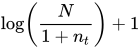
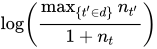
"the"という語が非常に普遍であるために、より意味のある単語である"brown"や"cow"に十分な重みを与えず、term frequencyは、"the"という語をより高頻度に含む文書を誤って強調してしまう傾向がある。"the"という語は、普遍的ではない"brown"や"cow"という語とは異なり、文書や単語がクエリに関連している・関連していないと区別するためのキーワードとしてよいものではない。それゆえに、文書集合において非常に出現頻度の高い語の重みを減らし、珍しい語の重みを増加させるため、inverse document frequency が用いられている。
Karen Spärck Jones (英語版 ) [4]
単語の特異性は、その単語が出現した文書数の逆関数によって定量化できる。
tf-idfは2つの統計量、term frequency (tf)と、inverse document frequency (idf) の積である。双方の統計量には、厳密な値を決定するために様々な手法が存在している。
式は、文書やWebページにおけるキーワードやフレーズの重要性を定義することを目的とする。
term frequency (tf) 重みの計算手法
重み付け手法
tf 重み
binary
(2値)
0
,
1
{\displaystyle {0,1}}
raw count
(出現頻度をそのまま使用)
f
t
,
d
{\displaystyle f_{t,d}}
term frequency
(標準的な単語頻度)
f
t
,
d
/
∑
t
′
∈
d
f
t
′
,
d
{\displaystyle f_{t,d}{\Bigg /}{\sum _{t'\in d}{f_{t',d}}}}
log normalization
(対数による正規化)
log
(
1
+
f
t
,
d
)
{\displaystyle \log(1+f_{t,d})}
double normalization 0.5
(二重0.5正規化)
0.5
+
0.5
⋅
f
t
,
d
max
{
t
′
∈
d
}
f
t
′
,
d
{\displaystyle 0.5+0.5\cdot {\frac {f_{t,d}}{\max _{\{t'\in d\}}{f_{t',d}}}}}
double normalization K
(二重K正規化)
K
+
(
1
−
K
)
f
t
,
d
max
{
t
′
∈
d
}
f
t
′
,
d
{\displaystyle K+(1-K){\frac {f_{t,d}}{\max _{\{t'\in d\}}{f_{t',d}}}}}
term frequency (tf) は文書d t
t
f
(
t
,
d
)
=
f
t
,
d
∑
t
′
∈
d
f
t
′
,
d
{\displaystyle \mathrm {tf} (t,d)={\frac {f_{t,d}}{\sum _{t'\in d}{f_{t',d}}}}}
f t ,d raw count )である。すなわち、語t が文書d に何回出現したかを意味する。単純には、分母には文書d tf(t ,d ) の定義は他にも様々なものがある[5] :128 。
ブール代数 に基づく「頻度」(binary): t がd に存在すれば、 tf(t ,d ) = 1 、 それ以外の場合はtf(t ,d ) = 0 ;出現頻度をそのまま用いる(raw count): tf(t ,d ) = f t ,d ;
文書の長さを調整するもの(term frequency, 上式と同じ): tf(t ,d ) = f t ,d ;
対数スケール の頻度(log normalization): tf(t ,d ) = log (1 + f t ,d [6] 長い文書に偏ることを防ぐために、拡張された頻度。例えば、ある語の出現回数が、文書内で最も出現頻度が高い語の出現回数で除算されるようにされているものなど。
t
f
(
t
,
d
)
=
0.5
+
0.5
⋅
f
t
,
d
max
{
f
t
′
,
d
:
t
′
∈
d
}
{\displaystyle \mathrm {tf} (t,d)=0.5+0.5\cdot {\frac {f_{t,d}}{\max\{f_{t',d}:t'\in d\}}}}
ここで、tf-idfは次のように計算される。
t
f
i
d
f
(
t
,
d
,
D
)
=
t
f
(
t
,
d
)
⋅
i
d
f
(
t
,
D
)
{\displaystyle \mathrm {tfidf} (t,d,D)=\mathrm {tf} (t,d)\cdot \mathrm {idf} (t,D)}
tf-idfの重みが高くなるのは、(与えられた文書内で)その単語の単語頻度(term frequency, tf)が高く、かつ、文書集合全体においてその単語の文書頻度(document frequency, df)が低い場合である。それゆえに、重みは普遍的な語をフィルタする傾向がある。idfの対数内の分数は常に1以上となるため、idf(とtf-idf)の値は常に0以上になる。単語がより多くの文書に現れる場合、対数の中の分数は1に近づき、それゆえにidfとtf-idfは0に近づく。
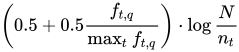
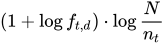
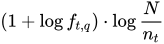
推奨されているtf–idf重み付け手法
重み付け手法
文書における利用
クエリにおける利用
1
f
t
,
d
⋅
log
N
n
t
{\displaystyle f_{t,d}\cdot \log {\frac {N}{n_{t}}}}
(
0.5
+
0.5
f
t
,
q
max
t
f
t
,
q
)
⋅
log
N
n
t
{\displaystyle \left(0.5+0.5{\frac {f_{t,q}}{\max _{t}f_{t,q}}}\right)\cdot \log {\frac {N}{n_{t}}}}
2
log
(
1
+
f
t
,
d
)
{\displaystyle \log(1+f_{t,d})}
log
(
1
+
N
n
t
)
{\displaystyle \log \left(1+{\frac {N}{n_{t}}}\right)}
3
(
1
+
log
f
t
,
d
)
⋅
log
N
n
t
{\displaystyle (1+\log f_{t,d})\cdot \log {\frac {N}{n_{t}}}}
(
1
+
log
f
t
,
q
)
⋅
log
N
n
t
{\displaystyle (1+\log f_{t,q})\cdot \log {\frac {N}{n_{t}}}}
idfは1972年のKaren Spärck Jones (英語版 ) ヒューリスティクス でうまくいくとされてきたにもかかわらず、その論理的な基礎は少なくとも30年以上悩みの種となっており、多くの研究者が情報理論 的な正当化を試み続けている[7]
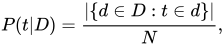
Spärck Jonesは自身の説明の中で、ジップの法則 を別にして、十分な理論を提供していない[7] d が語t を含む確率を、相対文書頻度として推定することによって、idfを確率論 的基盤に置こうとする試みが行われてきている[8]
P
(
t
|
D
)
=
|
{
d
∈
D
:
t
∈
d
}
|
N
,
{\displaystyle P(t|D)={\frac {|\{d\in D:t\in d\}|}{N}},}
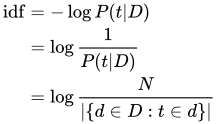
idfを次のように定義すると、
i
d
f
=
−
log
P
(
t
|
D
)
=
log
1
P
(
t
|
D
)
=
log
N
|
{
d
∈
D
:
t
∈
d
}
|
{\displaystyle {\begin{aligned}\mathrm {idf} &=-\log P(t|D)\\&=\log {\frac {1}{P(t|D)}}\\&=\log {\frac {N}{|\{d\in D:t\in d\}|}}\end{aligned}}}
つまり、逆文書頻度は対数を取った「逆」相対文書頻度となる。
また、この確率論的解釈は自己情報量 と同じ形を取る。しかし、そのような情報理論的概念を情報検索の問題に応用すると、必要な確率分布 に適切な確率空間 を定義する際、文書だけでなく、クエリや単語を考慮する必要があるため、問題が生ずる[7]
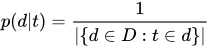
term frequency (tf) とinverse document frequency (idf) の両者は情報理論 の観点から定式化されうる。この考えは、なぜそれらの積が文書の結合情報量 の観点から意味があるのかを理解するのに役立つ。分布
p
(
d
,
t
)
{\displaystyle p(d,t)}
p
(
d
|
t
)
=
1
|
{
d
∈
D
:
t
∈
d
}
|
{\displaystyle p(d|t)={\frac {1}{|\{d\in D:t\in d\}|}}}
この仮定とその意味は、Aizawaによれば、「ヒューリスティックなtf-idfの使われ方を表している。」という[9]
特定の語
t
{\displaystyle t}
D
{\displaystyle D}
条件付きエントロピー (英語版 )
H
(
D
|
T
=
t
)
=
−
∑
d
p
d
|
t
log
p
d
|
t
=
−
log
1
|
{
d
∈
D
:
t
∈
d
}
|
=
log
|
{
d
∈
D
:
t
∈
d
}
|
|
D
|
+
log
|
D
|
=
−
i
d
f
(
t
)
+
log
|
D
|
{\displaystyle H({\cal {D}}|{\cal {T}}=t)=-\sum _{d}p_{d|t}\log p_{d|t}=-\log {\frac {1}{|\{d\in D:t\in d\}|}}=\log {\frac {|\{d\in D:t\in d\}|}{|D|}}+\log |D|=-\mathrm {idf} (t)+\log |D|}
表記に関して、
D
{\displaystyle {\cal {D}}}
T
{\displaystyle {\cal {T}}}
相互情報量 は以下のように表される。
M
(
T
;
D
)
=
H
(
D
)
−
H
(
D
|
T
)
=
∑
t
p
t
⋅
(
H
(
D
)
−
H
(
D
|
W
=
t
)
)
=
∑
t
p
t
⋅
i
d
f
(
t
)
{\displaystyle M({\cal {T}};{\cal {D}})=H({\cal {D}})-H({\cal {D}}|{\cal {T}})=\sum _{t}p_{t}\cdot (H({\cal {D}})-H({\cal {D}}|W=t))=\sum _{t}p_{t}\cdot \mathrm {idf} (t)}
最後のステップは
p
t
{\displaystyle p_{t}}
M
(
T
;
D
)
=
∑
t
,
d
p
t
|
d
⋅
p
d
⋅
i
d
f
(
t
)
=
∑
t
,
d
t
f
(
t
,
d
)
⋅
1
|
D
|
⋅
i
d
f
(
t
)
=
1
|
D
|
∑
t
,
d
t
f
(
t
,
d
)
⋅
i
d
f
(
t
)
.
{\displaystyle M({\cal {T}};{\cal {D}})=\sum _{t,d}p_{t|d}\cdot p_{d}\cdot \mathrm {idf} (t)=\sum _{t,d}\mathrm {tf} (t,d)\cdot {\frac {1}{|D|}}\cdot \mathrm {idf} (t)={\frac {1}{|D|}}\sum _{t,d}\mathrm {tf} (t,d)\cdot \mathrm {idf} (t).}
この式は、すべての有効な単語と文書のtf-idfの和は、文書と単語の同時確率分布 の特異性のすべてを考慮した、文書と単語の間の相互情報量に立ち戻ることを表している[9] bit of information)」を意味している。
2つの文書からのみ構成されるコーパスの単語カウント表(右に示す)を扱うと仮定する。
文書2
語
語のカウント
this 1
is
1
another
2
example
3
文書1
語
語のカウント
this 1
is
1
a
2
sample
1
語"this"のtf-idfは以下のように計算される。
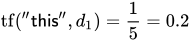
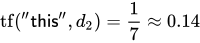
出現頻度をそのままtfとして用いる場合、tfはそれぞれの文書の"this"の頻度と同じになる。標準的な文書長を調整するtfでは、各文書において単語"this"は1度現れるが、文書2はより多くの単語を含むため、相対頻度は小さくなる。
t
f
(
″
t
h
i
s
″
,
d
1
)
=
1
5
=
0.2
{\displaystyle \mathrm {tf} ({\mathsf {''this''}},d_{1})={\frac {1}{5}}=0.2}
t
f
(
″
t
h
i
s
″
,
d
2
)
=
1
7
≈
0.14
{\displaystyle \mathrm {tf} ({\mathsf {''this''}},d_{2})={\frac {1}{7}}\approx 0.14}
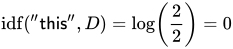
idfはコーパス毎の定数であり、"this"という単語を含む文書の比率から成り立って いる。この事例では、2つの文書からなるコーパスを扱い、それらはすべて"this"という語を含んでいる。
i
d
f
(
″
t
h
i
s
″
,
D
)
=
log
(
2
2
)
=
0
{\displaystyle \mathrm {idf} ({\mathsf {''this''}},D)=\log \left({\frac {2}{2}}\right)=0}
つまり、"this"という語のtf-idfはゼロである。これはこの単語がすべての文書に現れることから、その単語が有益でないでないこと示唆している。
t
f
i
d
f
(
″
t
h
i
s
″
,
d
1
,
D
)
=
0.2
×
0
=
0
{\displaystyle \mathrm {tfidf} ({\mathsf {''this''}},d_{1},D)=0.2\times 0=0}
t
f
i
d
f
(
″
t
h
i
s
″
,
d
2
,
D
)
=
0.14
×
0
=
0
{\displaystyle \mathrm {tfidf} ({\mathsf {''this''}},d_{2},D)=0.14\times 0=0}
"example"という語はより興味深く――3度現れるが、文書2にしか現れない。
t
f
(
″
e
x
a
m
p
l
e
″
,
d
1
)
=
0
5
=
0
{\displaystyle \mathrm {tf} ({\mathsf {''example''}},d_{1})={\frac {0}{5}}=0}
t
f
(
″
e
x
a
m
p
l
e
″
,
d
2
)
=
3
7
≈
0.429
{\displaystyle \mathrm {tf} ({\mathsf {''example''}},d_{2})={\frac {3}{7}}\approx 0.429}
i
d
f
(
″
e
x
a
m
p
l
e
″
,
D
)
=
log
(
2
1
)
=
0.301
{\displaystyle \mathrm {idf} ({\mathsf {''example''}},D)=\log \left({\frac {2}{1}}\right)=0.301}
最終的には,
t
f
i
d
f
(
″
e
x
a
m
p
l
e
″
,
d
1
,
D
)
=
t
f
(
″
e
x
a
m
p
l
e
″
,
d
1
)
×
i
d
f
(
″
e
x
a
m
p
l
e
″
,
D
)
=
0
×
0.301
=
0
{\displaystyle \mathrm {tfidf} ({\mathsf {''example''}},d_{1},D)=\mathrm {tf} ({\mathsf {''example''}},d_{1})\times \mathrm {idf} ({\mathsf {''example''}},D)=0\times 0.301=0}
t
f
i
d
f
(
″
e
x
a
m
p
l
e
″
,
d
2
,
D
)
=
t
f
(
″
e
x
a
m
p
l
e
″
,
d
2
)
×
i
d
f
(
″
e
x
a
m
p
l
e
″
,
D
)
=
0.429
×
0.301
≈
0.129
{\displaystyle \mathrm {tfidf} ({\mathsf {''example''}},d_{2},D)=\mathrm {tf} ({\mathsf {''example''}},d_{2})\times \mathrm {idf} ({\mathsf {''example''}},D)=0.429\times 0.301\approx 0.129}
(対数は常用対数 を用いている。)
tf-idfの背後にある考えは、単語以外の存在にも応用される。1998年 にはidfのコンセプトが引用分析 に応用された[10] 物体マッチング を行うための「visual words (英語版 ) [11] [12] [13]
多数の単語重み付け手法はtf-idfからの派生である。そのうちの一つはTF-PDF (term frequency * proportional document frequency) である[14] 2001年 にメディアにおける新たなトピックを特定するという文脈で導入された。PDF成分は異なるドメインの中でどのくらいの頻度である単語が出現したかの差を測定する。他の派生にはTF-IDuFがある。TF-IDuFでは[15] ユーザーモデリング (英語版 )
↑ Rajaraman, A.; Ullman, J.D. (2011). “Data Mining” . Mining of Massive Datasets . pp. 1–17. doi :10.1017/CBO9781139058452.002 . ISBN 978-1-139-05845-2 . http://i.stanford.edu/~ullman/mmds/ch1.pdf ↑ Breitinger, Corinna; Gipp, Bela; Langer, Stefan (2015-07-26). “Research-paper recommender systems: a literature survey” (英語). International Journal on Digital Libraries 17 (4): 305–338. doi :10.1007/s00799-015-0156-0 . ISSN 1432-5012 . http://nbn-resolving.de/urn:nbn:de:bsz:352-0-311312 . ↑ Luhn, Hans Peter (1957). “A Statistical Approach to Mechanized Encoding and Searching of Literary Information” . IBM Journal of Research and Development 1 (4): 309–317. doi :10.1147/rd.14.0309 . https://web.stanford.edu/class/linguist289/luhn57.pdf 2 March 2015 閲覧 "There is also the probability that the more frequently a notion and combination of notions occur, the more importance the author attaches to them as reflecting the essence of his overall idea." ↑ Spärck Jones, K. (1972). “A Statistical Interpretation of Term Specificity and Its Application in Retrieval”. Journal of Documentation 28 : 11–21. doi :10.1108/eb026526 . ↑ Manning, C.D.; Raghavan, P.; Schutze, H. (2008). “Scoring, term weighting, and the vector space model” . Introduction to Information Retrieval . pp. 100. doi :10.1017/CBO9780511809071.007 . ISBN 978-0-511-80907-1 . http://nlp.stanford.edu/IR-book/pdf/06vect.pdf ↑ “TFIDF statistics | SAX-VSM ”. 2022年3月29日 閲覧。 1 2 3 Robertson, S. (2004). “Understanding inverse document frequency: On theoretical arguments for IDF”. Journal of Documentation 60 (5): 503–520. doi :10.1108/00220410410560582 . ↑ See also Probability estimates in practice in Introduction to Information Retrieval . 1 2 Aizawa, Akiko (2003). “An information-theoretic perspective of tf–idf measures” (英語). Information Processing and Management 39 (1): 45–65. doi :10.1016/S0306-4573(02)00021-3 . ↑ Bollacker, Kurt D.; Lawrence, Steve; Giles, C. Lee (1998-01-01). CiteSeer: An Autonomous Web Agent for Automatic Retrieval and Identification of Interesting Publications AGENTS '98. 116–123. doi :10.1145/280765.280786 . ISBN 978-0-89791-983-8 . https://www.semanticscholar.org/paper/b23a5a62b7cb5278ceb5a6cc021c28a92041d792 ↑ Sivic, Josef; Zisserman, Andrew (2003-01-01). Video Google: A Text Retrieval Approach to Object Matching in Videos ICCV '03. 1470–. doi :10.1109/ICCV.2003.1238663 . ISBN 978-0-7695-1950-0 . http://dl.acm.org/citation.cfm?id=946247.946751 ↑ Seki, Yohei. “Sentence Extraction by tf/idf and Position Weighting from Newspaper Articles ”. National Institute of Informatics. 2022年3月29日 閲覧。 ↑ Beel, Joeran; Breitinger, Corinna (2017). “Evaluating the CC-IDF citation-weighting scheme – How effectively can 'Inverse Document Frequency' (IDF) be applied to references?” . Proceedings of the 12th IConference . http://beel.org/publications/2017%20iConference%20--%20Evaluating%20the%20CC-IDF%20citation-weighting%20scheme%20--%20preprint.pdf . ↑ Khoo Khyou Bun; Bun, Khoo Khyou; Ishizuka, M. (2001) (英語). Emerging Topic Tracking System . 2. doi :10.1109/wecwis.2001.933900 . ISBN 978-0-7695-1224-2 ↑ Langer, Stefan; Gipp, Bela (2017). “TF-IDuF: A Novel Term-Weighting Scheme for User Modeling based on Users' Personal Document Collections” . IConference . https://www.gipp.com/wp-content/papercite-data/pdf/beel17.pdf .
Salton, G; McGill, M. J. (1986). Introduction to modern information retrieval McGraw-Hill . ISBN 978-0-07-054484-0 . https://archive.org/details/introductiontomo00salt Salton, G.; Fox, E. A.; Wu, H. (1983). “Extended Boolean information retrieval”. Communications of the ACM 26 (11): 1022–1036. doi :10.1145/182.358466 . hdl :1813/6351 Salton, G.; Buckley, C. (1988). “Term-weighting approaches in automatic text retrieval” . Information Processing & Management 24 (5): 513–523. doi :10.1016/0306-4573(88)90021-0 . hdl :1813/6721 . https://ecommons.cornell.edu/bitstream/1813/6721/1/87-881.pdf . Wu, H. C.; Luk, R.W.P.; Wong, K.F.; Kwok, K.L. (2008). “Interpreting TF-IDF term weights as making relevance decisions” . ACM Transactions on Information Systems 26 (3): 1. doi :10.1145/1361684.1361686 . hdl :10397/10130 . https://www.semanticscholar.org/paper/f6bbbf2cc785cf96019dcd9c41ab1801aad962dd .
⌬ Phoenix Mesh
CID:
未登録
IPFS未登録
📡 0ピア
N=1
CRITICAL
PQS A90
🔍 P2P検証
⌬ 守護者になる
×
⌬ あなたはすでに守護者です
このページを読んだ瞬間、あなたのブラウザはIPFSノードとして起動し、この記事のNakamoto係数(NK) を+1しました。
読んだという事実が暗号学的証明になる — Proof of Read について →
🌐 ブラウザシーダー(自動起動中)
閲覧 = シーダー参加 です。何もしなくていい。永続モード にすると読んだ記事がブラウザに保存され、次回以降タブを開くだけで自動シーダーになります。
💾 永続モードに切り替える
🔄 セッションのみ(現在)
不参加
方法3: コマンドライン
ipfs pin add IPFSに未登録
閉じる